Cozumel's weather is less variable than most Caribbean islands and its conditions are more variable than people expect, because two different things can interrupt a trip here and they happen at opposite ends of the year. Hurricane season is the one everybody knows about. The norte is the one that actually strands more visitors.
The one-line answer
March and April. March is the driest month on the island, the winter wind events have faded out by the middle of it, the sea is climbing out of the low eighties and the crowds have not yet thinned in a way that closes anything. If you get one window and no other constraint, take it.
Month by month
Figures below are rounded monthly normals in Fahrenheit, not forecasts.
| Month | Air high | Sea | Rain | Crowds | What defines it |
|---|---|---|---|---|---|
| January | low 80s | ~80 | low | high | Nortes; eagle rays on the deep sites |
| February | low 80s | ~79 | low | high | Carnaval; coolest sea of the year |
| March | mid 80s | ~80 | lowest | high | The driest month. The best all-round |
| April | upper 80s | ~81 | low | high | El Cedral fair; sargassum begins on the mainland |
| May | upper 80s | ~83 | rising | moderate | Turtle nesting starts on the east coast |
| June | around 90 | ~84 | wet | moderate | Hurricane season opens June 1 |
| July | around 90 | ~84 | wet | moderate | Whale sharks off the mainland, as a day trip |
| August | around 90 | ~85 | wet | lower | Peak-risk hurricane window opens |
| September | around 90 | ~85 | wet | lowest | Cheapest, quietest, most closures |
| October | upper 80s | ~84 | wettest | low | Wettest month; Día de Muertos at the end |
| November | mid 80s | ~82 | easing | rising | Season ends Nov 30; first nortes |
| December | low 80s | ~81 | low | high from mid-month | High-season pricing arrives |
The norte, which is the local thing
From roughly mid-November to mid-March, a norte is a strong northerly wind event that pushes down the Cozumel Channel. It arrives with a front, it lasts a day or two, and its effect on a holiday is disproportionate to how it looks from a hotel balcony.
What a norte does:
- The harbourmaster can close the port. When that happens the Playa del Carmen ferries stop and the small boats stay tied up.
- Dive boats do not sail, or sail only to the sheltered near-town sites. The deep southern sites at Punta Sur and Maracaibo are the first to be cancelled.
- The leeward west coast, which is flat almost every other day of the year, gets choppy. Shore snorkelling at Dzul-Ha goes from excellent to pointless.
- Beach club water toys come in.
What it does not do is ruin a trip that has margin in it. It ruins trips that do not. Never schedule the ferry for the same day as an international flight between November and March. Leave a buffer night on the mainland, or fly out of Cozumel's own airport. This is the single most useful piece of winter planning advice on this island.
Hurricane season
Runs June 1 to November 30, with the genuine risk concentrated August to October. Most of the season is not hurricanes. It is short, heavy afternoon storms that build, rain hard, and clear, with the sea at its warmest all year.
The planning version:
- Book refundable where you can, and read the storm clause before you pay.
- Travel insurance bought after a storm has been named is generally useless for that storm. Buy it at the time of booking or not at all.
- A named storm in the western Caribbean reshapes cruise itineraries well before it reaches anywhere, and Cozumel is one of the first calls swapped out. If your call gets cancelled, that is the system working.
- September is the cheapest and quietest month here and also the peak of the risk. That is a genuine trade-off, and worth making deliberately rather than by accident.
One September-specific thing that catches people: a number of small dive shops, restaurants and east-coast bars take their annual maintenance closure then. Confirm directly that the operator you booked is open, rather than assuming.
Sargassum, and the comparison that actually helps
Sargassum seaweed affects the whole Mexican Caribbean seasonally, typically building from around April through August and varying enormously year to year.
The useful fact is comparative. Cozumel's developed west shore gets substantially less sargassum than the mainland Riviera Maya, because the island sits between that shore and the open water the weed arrives on. In a heavy year, that is a real argument for Cozumel over Playa del Carmen or Tulum.
It is a tendency, not a guarantee. A sustained onshore wind can push weed onto the west coast for a few days, and Cozumel's east coast collects the island's share year-round. If it matters to your trip, look at recent photographs from the specific beach club rather than a seasonal map. And note that boat trips to Palancar and El Cielo are unaffected by whatever is on the sand.
The diving calendar
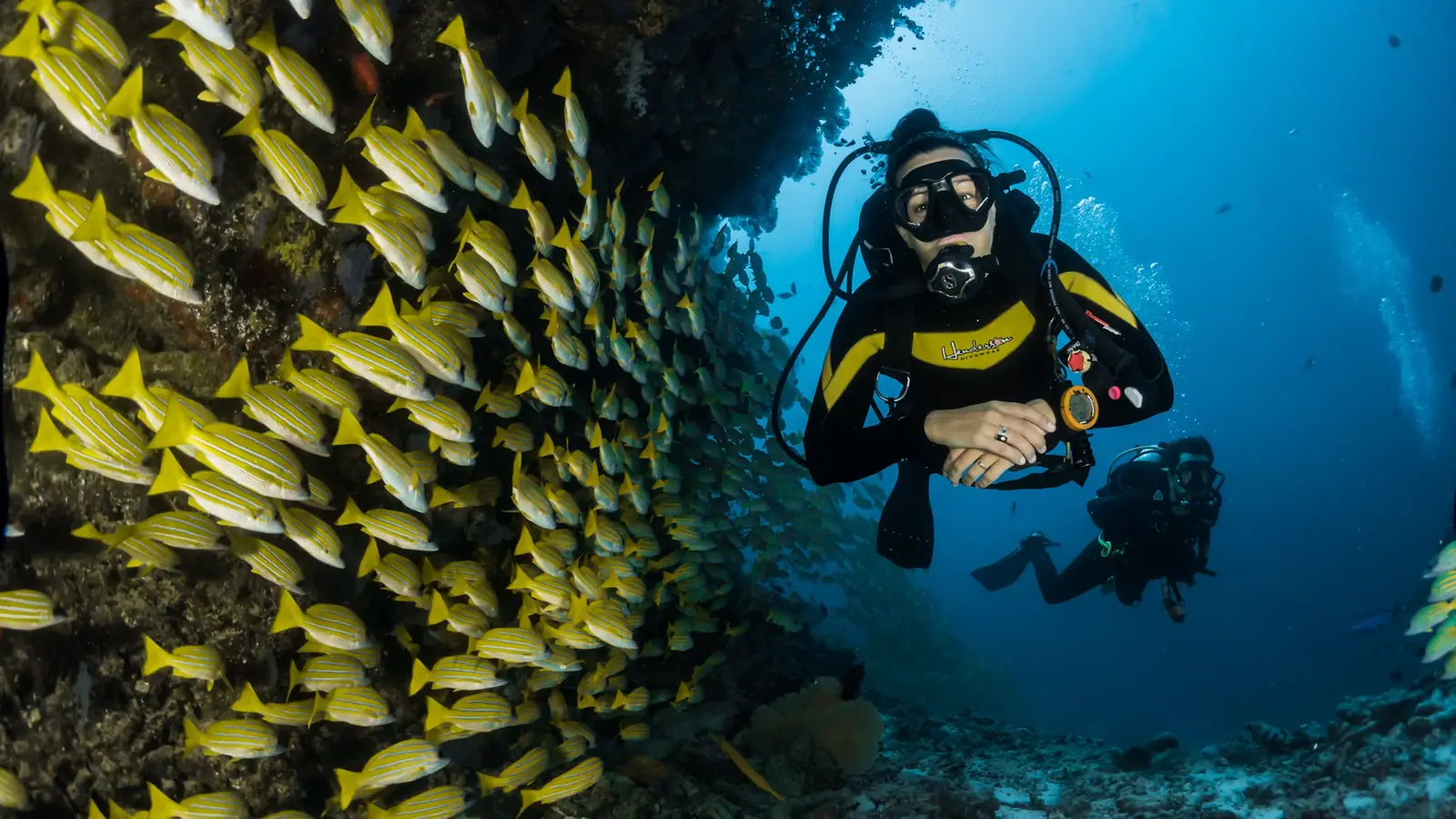
Visibility is good here year-round, which is what a permanent flushing current does. What changes is temperature, what the current is doing and what turns up.
- December to February: sea around 79 to 80, the coolest of the year. Most divers want a 3mm suit; the warm-blooded manage in a shorty. This is also eagle ray season on the deeper northern and southern sites, which is why experienced divers book it and accept the nortes.
- March to May: the sweet spot. Calm, dry, sea climbing into the low eighties.
- June to October: mid-eighties water, warm enough that plenty of people dive in a rash guard. Afternoon storms rather than all-day rain. Cheapest boat prices of the year.
- November: transitional. Still warm, first fronts arriving.
Whatever month you pick, the back-end rule does not move: at least eighteen hours between your last dive and going to altitude, which removes the departure morning from the schedule.
Festivals worth planning around
Carnaval is the island's own festival and it is a genuine community event rather than a tourist product — parades on the malecón, comparsas, several nights of them. It moves with the church calendar, running in the days before Ash Wednesday, which puts it in February or early March depending on the year. Accommodation in San Miguel tightens.
Día de Muertos, 31 October to 2 November, is observed here as it is across Mexico, with altars and cemetery visits. It is not a parade laid on for visitors. Watch respectfully and do not photograph families at graves.
The El Cedral fair, around the end of April and the start of May, is the island's oldest celebration, held in the village at the site of its earliest settlement — bullfights, rodeo, music and a religious procession, and almost entirely local.
Dates for all three should be confirmed locally in the year you travel.
Pick your month by what you came for
Divers chasing eagle rays: January and February. Cool water, the deep sites at their best, and the acceptance that a norte may cost you a day.
Divers on a budget: June and July. Warm water, low boat prices, afternoon storms that mostly miss the morning two-tank.
Families: March and April, or late June once schools break. Calmest water of the year in spring, shortest rain, and the beach clubs not yet at their most crowded.
Cruise passengers: you do not choose, but know that December to April is peak cruise volume, which means more ships in port, longer taxi queues and busier moorings at Palancar. A shoulder-season call has the same island with a third fewer people on it.
Anyone avoiding crowds and price: September, with the risk understood and some operators closed.
Anyone who wants the island itself rather than the product: February for Carnaval, or the end of October for Día de Muertos. Both are the town being itself.
Anyone with zero flexibility on the return flight: avoid the ferry in winter entirely. Fly in and out of CZM, or leave a buffer night on the mainland.
Packing for the month you chose
December to March. A 3mm wetsuit if you own one, or budget to rent. An actual jacket or fleece for the evening on the malecón when a norte is blowing, which surprises people every winter. Long sleeves for the boat, where wind chill on a wet body in February is real.
April and May. Rash guard, the lightest possible everything, and a hat that will not leave in the breeze. This is when the sun starts to be the main event.
June to October. A light rain layer, not a heavy one — the storms are short and warm and an umbrella beats a coat. Quick-dry clothing, because nothing air-dries properly in August humidity. Mosquito repellent for the inland sites and San Gervasio, which is jungle and behaves like it after rain.
Any month. Reef-safe sunscreen and, better, a long-sleeved rash vest, because the UV between eleven and three sits at the top of the scale most of the year. A mask that fits you. Motion sickness tablets if the ferry is in the plan. And small pesos in small notes, because the east-coast bars, the park gates and the marine park fee are cash transactions whatever the weather is doing.
Last updated
Opening hours, ordinances and prices move with the season. We re-check this guide rather than rewrite it, and the date above is the last time someone did. How we research and correct.